Stephen R. Lawhead: The Serendipity of Creativity
I was looking for a little inspiration in my own fantasy writing and got it.
Stan Guthrie
2/21/20262 min read
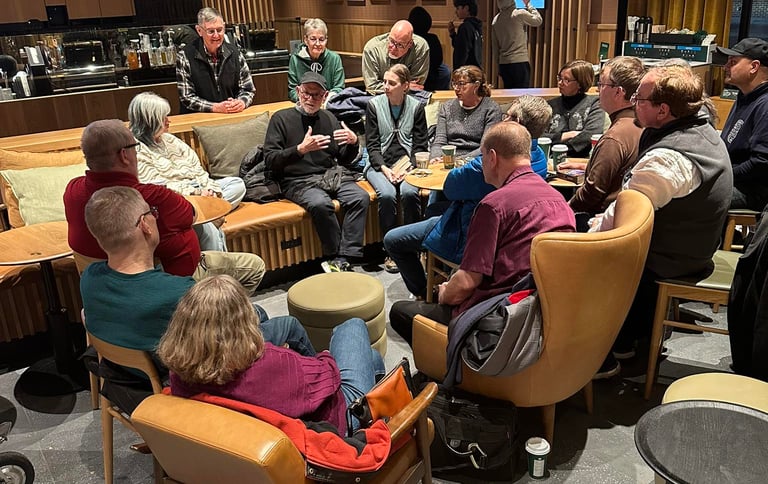
On a very cold evening, Christine and I attended Stephen R. Lawhead's gathering with readers at the downtown Starbucks in Wheaton last night (we're in the lower left corner of the photo). I was looking for a little info and inspiration for my own fantasy writing and got both.
Stephen, according to Wikipedia, is "known for his works of fantasy, science fiction, and historical fiction, particularly Celtic historical fiction. He has written over 28 novels and numerous children's and non-fiction books." As a result of his visit, I'm planning to read his Pendragon Cycle.
Stephen (he's a nice guy and so I'll use his first name) told me he started writing stories when he was twelve. I think I have him beat by a few years, as I recall a particular tale when I was a tyke. It was about an amphibian named "Froggie," co-authored with my mother. But who's keeping track?
Stephen said he got into the writing profession after taking a creative writing class taught by Harold Myra, eventually the publisher of Christianity Today. Harold invited him to come work at CT. I also worked under Harold (another nice guy). In his journey Stephen also worked at the now-defunct Campus Life magazine, where he started publishing his fiction. Along the way, Stephen served as (of all things) manager of DeGarmo and Key, a talented Christian pop duo back in the day.
Stephen travels a lot and picks up writing ideas everywhere he goes. He mentioned that once in the U.K. he picked up a museum brochure listing (if I remember correctly) the fourteen battlefields of King Arthur. That was enough to get him started on a big idea. I was reminded that the more we feed our imagination through good things such as travel and reading, the deeper and better our writing will become for our readers. Improvement as a writer never stops.
I asked Stephen for his philosophy of writing. He said he hopes to draw readers into an experience of the good, the true, and the beautiful, and their ultimate source. He doesn't aim to present "messages" to readers but to draw them into a world and into the characters that populate it. People bring something of themselves into the story and interpret what they read in that light. Stephen says that many times his characters emerge organically while he is writing. Sometimes they serve a natural function in the story (taking the reader from Point A, to Point B) and then take off from there.
I have observed a similar process with my own characters, who are there to accomplish something but then become so interesting that I cannot send them packing. It's not always planned. Sometimes stuff just occurs to me.
I guess that's the serendipity of creativity.